
Designing a Patient Insights Dashboard
Role: Senior UX researcher and designer
Timeline: November 2025 — April 2026
What I did:
Led the UX design of a patient insights dashboard for doctors that used DIGITIVA to help treat their patients. This tool would enable doctors to make clinical decisions more efficiently.
Facilitated in defining user requirement specifications and prioritization to bridge the gap between product and business development. Prioritization shifted throughout the project to match discoveries and timelines.
Conducted concept testing with real users throughout the iteration process to ensure the interface aligned with user needs and preferences.
Built a design system with a large component library, tokens, and variables for seamless development, scalability, and consistent visual language.
The problem:
The doctors who were using DIGITIVA to treat their patients with heart failure were spending lots of time each day reviewing unfiltered PDF health reports that were being generated.
To continue increasing product adoption across their health systems, the doctors that partnered with DIGITIVA expressed strong feedback that we needed improve the mode in which they received reports (automated emailed .zip folders) so they could be more efficient in their reviews.
The solution:
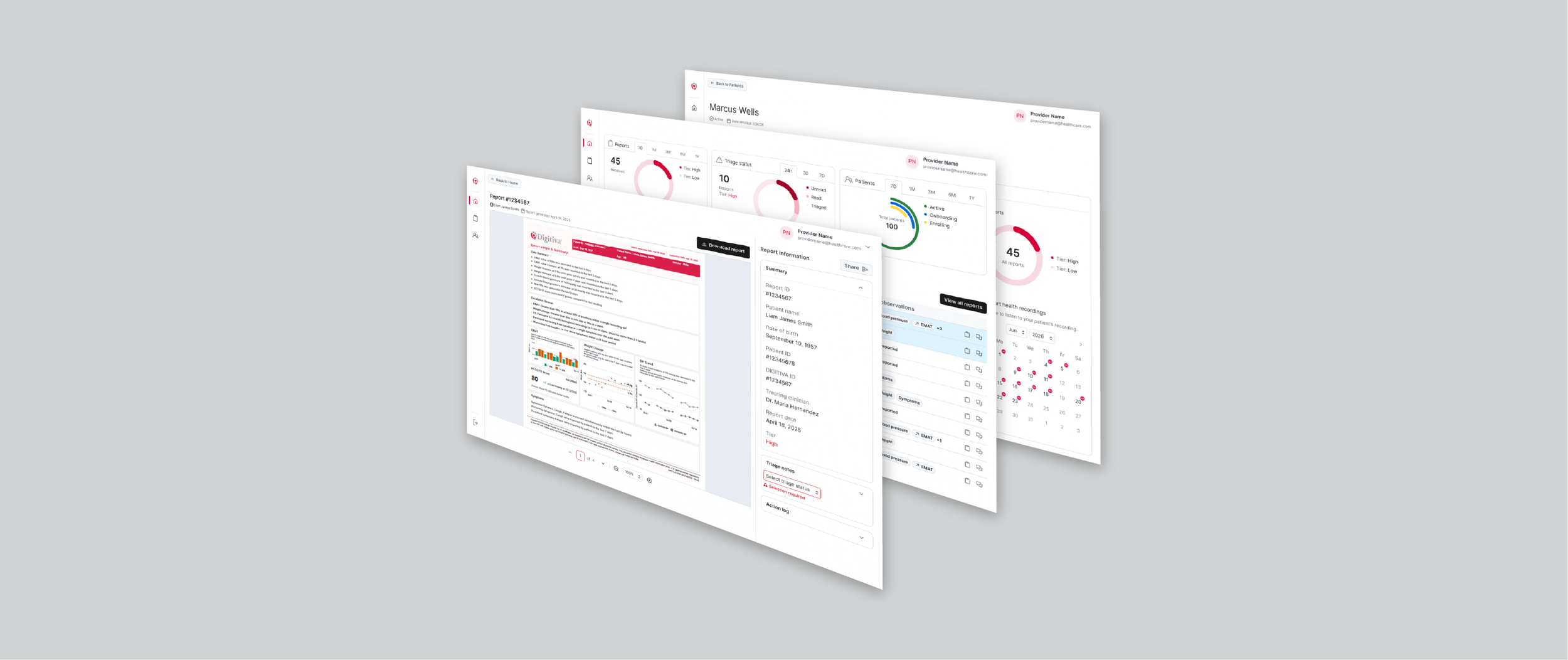
DIGITIVA Care Connect was a portal designed for doctors to receive, view, and share patient reports with more focus on the data that mattered most. We worked closely with users to craft this solution which could passively alert the doctors to reports that needed urgent review, ultimately cutting the costly time spent reviewing the majority of reports that had no clinical actionability.
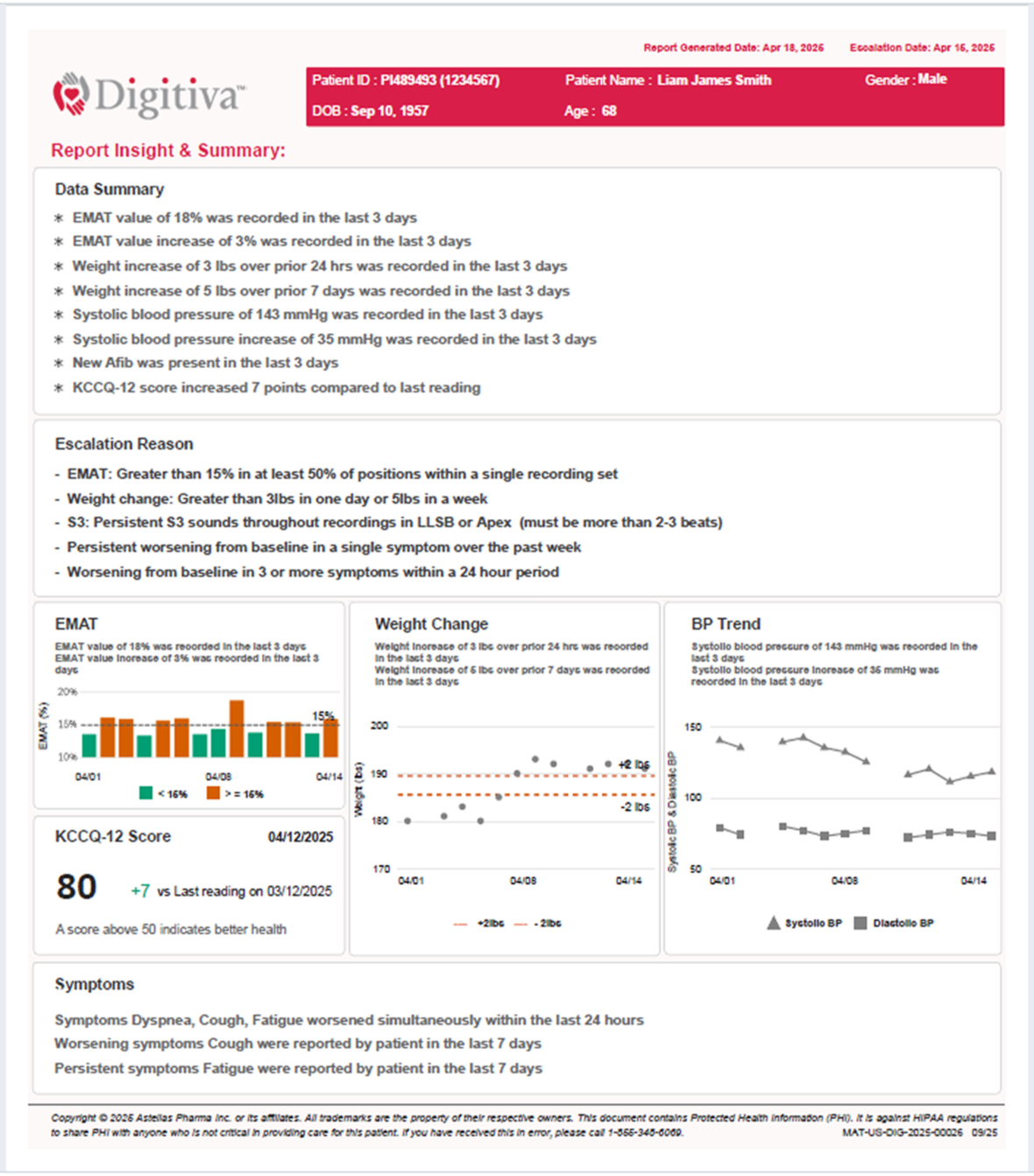
Example of a DIGITIVA remote monitoring report that doctors would receive every three to seven days containing patient health trends and information.
DIGITIVA generated reports on patients’ heart failure disease progression by aggregating user reported symptoms and heart recordings into individualized reports every three days and seven days.
Doctors reviewed every report that came in for each of their patients (which could be dozens a day) and found that only a small minority of those reports resulted in a clinical action such as medication changes.
Background
Defining the problem
In our recurring meetings with doctor using DIGITIVA, several key pain points in their workflow were consistently coming up:
Doctors spent over an hour every day reviewing patient reports individually for signs of worsening heart failure and wanted this process to be more efficient.
Searching the automated emails that contained daily reports in a .zip folder was a clunky user experience and led to an unorganized process with inefficiencies.
Health systems were often assigning just one doctor to review all of the reports due to the delivery method, creating a bottleneck in patient treatment.
Though the DIGITIVA team had recently updated the design of the reports to be easier to review by emphasizing key patient findings, doctors still had difficulty with the overall volume. After conducting three user interviews and weekly informal conversations with doctors, I created a problem statement.
Problem statement:
How might we increase the efficiency of reviewing daily DIGITIVA reports by surfacing key details and reducing friction between the users and accessing reports while maintaining the doctors’ autonomy over patient diagnoses and oversight?
Exploring the space and brainstorming
We evaluated the competitive landscape and surfaced two viable solutions to address our problem statement: data integration with electronic health record systems (EHRs) or developing a custom web portal.
After cross-functional conversations with product managers, operations, software development, and external stakeholders, we decided to develop a custom web portal to meet development timelines and user needs. We would plan to integrate our portal with EHRs further down the product roadmap.
From there, I wrote user stories to help define the user specification requirements and task flows.
User story 1
As a doctor, I want to DIGITIVA report data to be easier to review so I can spend less time looking at routine reports and more time making diagnoses.
Next steps
Design a real-time patient data tracker to limit unnecessary reports and only alert to most critical patient changes
Explore integration into healthcare organization patient charting tools (EHRs) like Epic Systems